> For the complete documentation index, see [llms.txt](https://docs.helpyousponsor.com/guides/llms.txt). Markdown versions of documentation pages are available by appending `.md` to page URLs; this page is available as [Markdown](https://docs.helpyousponsor.com/guides/administration/permissions-and-access-control.md).

# Permissions and Access Control

Permission sets control what an admin can see and do in your Gratona workspace. Access is determined by the module level, the records included in scope, and any safety restrictions that remove sensitive actions.

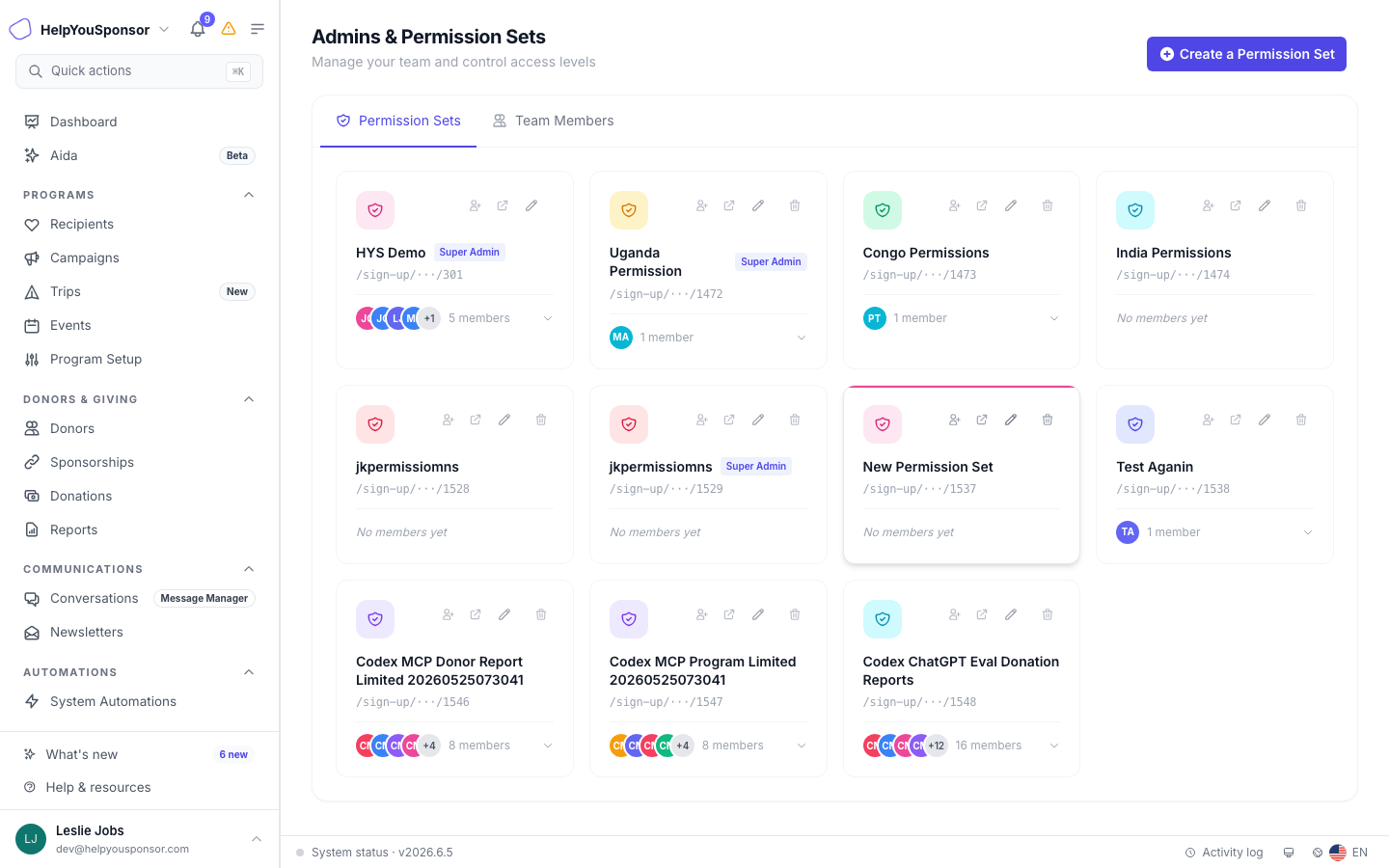
To navigate to Permissions and Access Control, open the quick actions menu (Cmd+K) and search for **Admins & Permissions**, or go directly to `/admin-options` in your browser. Select the **Permission Sets** tab.

<figure><img src="/files/mrWsAzGuN87zSD21m3Ss" alt="Admins and Permission Sets page with the Permission Sets tab open"><figcaption><p>Admins &#x26; Permission Sets — Permission Sets tab</p></figcaption></figure>

Here you can see the Permission Sets you have in the account.

From here you can perform actions like;

* Creating a permission set
* Editing a permission set
* Deleting a permission set

### Creating a permission set

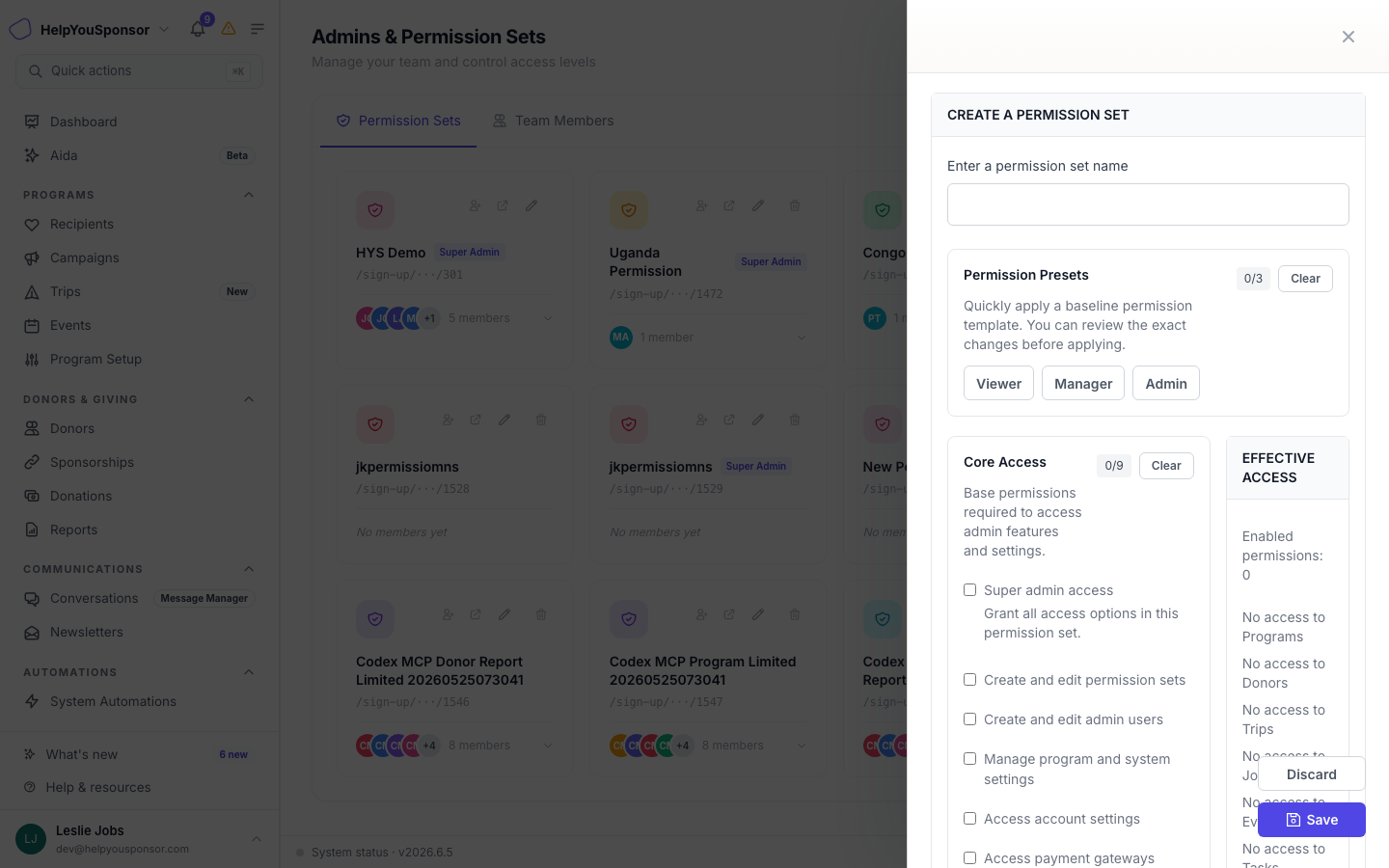
To create a permission set, click the **Create a Permission Set** button. This will open up a drawer to set up your permission set.

<figure><img src="/files/F7ptuK2L33Ir2iYjTeis" alt="Create Permission Set drawer with the four permission sections" width="500"><figcaption><p>Create Permission Set drawer with the four permission sections</p></figcaption></figure>

From here you can configure permissions across four sections:

* **Core Access** — Super admin, create/edit permission sets, create/edit admin users, manage settings, and related controls.
* **Module Access** — Programs, Donors, Trips, Journeys, Events, and other modules with None / View / Manage levels.
* **Scoped Access** — Program-level scoping, donor-form scoping, and setting blocks.
* **Safety Restrictions** — Toggleable blocks for message approval, archiving, restoring, and deleting.

Access checkboxes grant capabilities. Checkboxes under **Safety Restrictions** do the opposite: a checked restriction blocks that action even when the related module is set to **Manage**.

> **NOTE:** Some areas, such as [Donor Intelligence](/guides/core-features/donor-management/wealth-insights.md), appear only when the related feature is enabled for your organization and the admin has the required access.

## Build access in three layers

Review all three layers when an admin can open a module but cannot see the expected records or action.

### 1. Module access

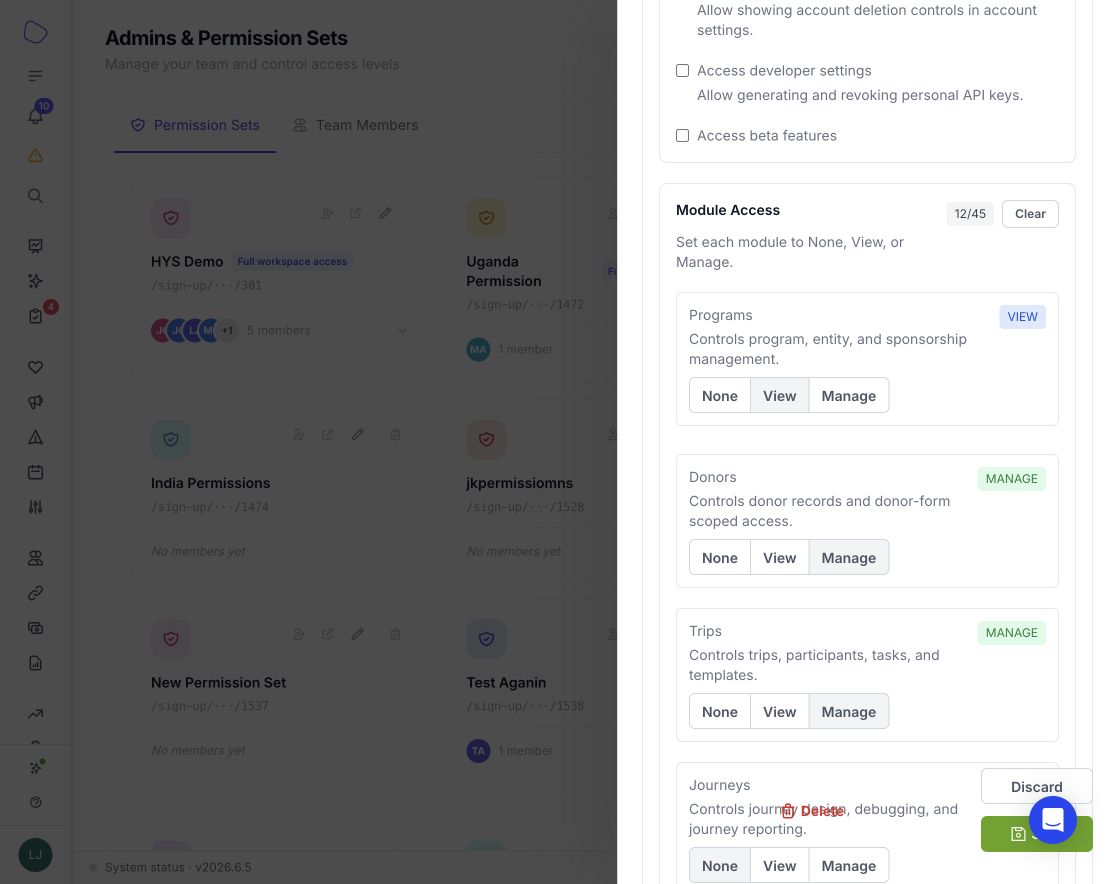
**Module Access** sets the broad level for areas such as Programs and Donors:

* **None** hides the module and does not grant access to its records.
* **View** allows read access.
* **Manage** allows the available create, edit, and operational actions.

A scoped program checkbox cannot grant access when the Programs module is set to **None**.

<figure><img src="/files/BckucwoQ6Xxwp9GDC4C1" alt="Permission set Module Access controls with None View and Manage levels"><figcaption><p>Module Access grants the broad None, View, or Manage level for each area.</p></figcaption></figure>

### 2. Scoped access

**Scoped Access** determines which records are included after module access is granted.

For programs, choose either:

* **Access all programs**, or
* one or more **Program: \[name]** entries.

Donor forms have the same pattern with **Access all donor forms** and individual **Donor form: \[name]** entries.

Program-setting blocks are subtractive. A checked **Block program setting: \[name]** entry hides and blocks that setting for the permission set.

### 3. Safety restrictions

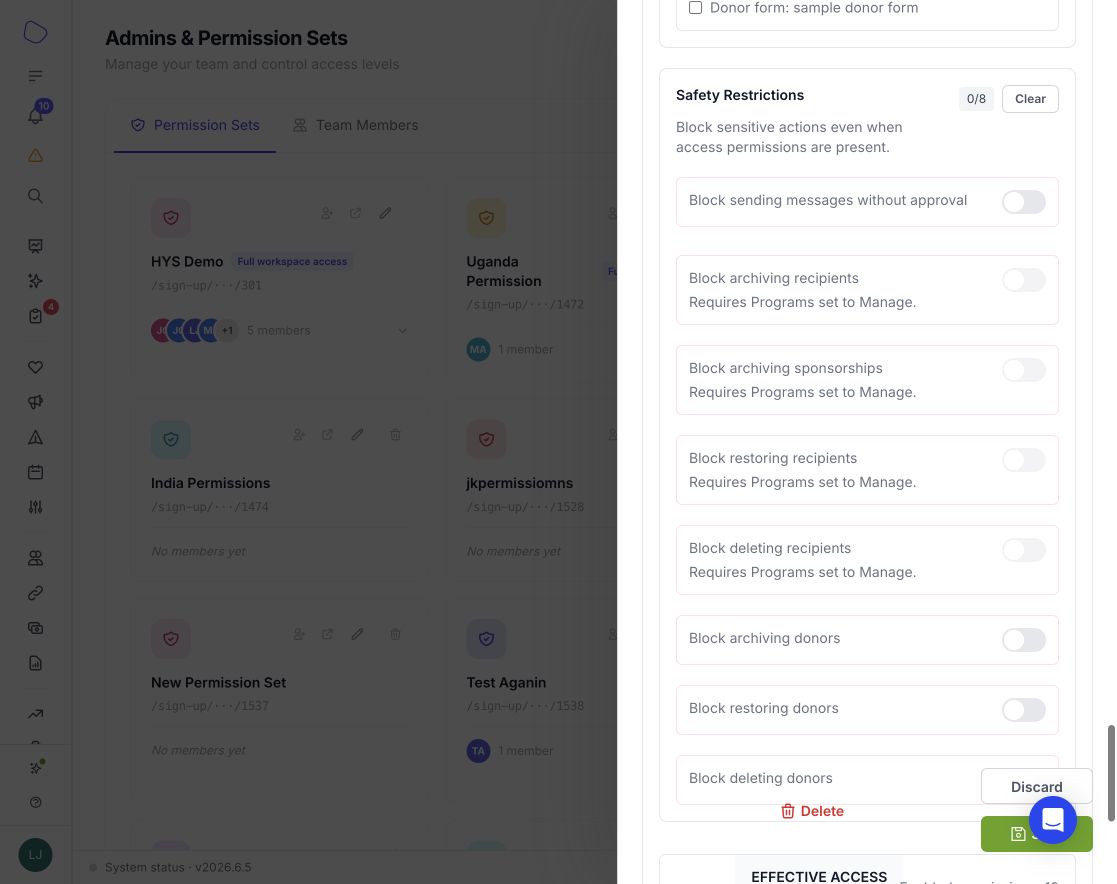
Safety restrictions remove sensitive actions. For example:

* **Block archiving recipients** controls recipient archive actions.
* **Block archiving sponsorships** controls sponsorship archive actions.
* donor archive, restore, and delete restrictions control the matching donor actions.

These restrictions are separate. Clearing **Block archiving recipients** does not allow sponsorship archiving when **Block archiving sponsorships** is still checked.

<figure><img src="/files/wSEvvIFeQdC6tl3JfdVW" alt="Permission set Safety Restrictions including recipient and sponsorship archive blocks"><figcaption><p>A checked Safety Restriction blocks that sensitive action even when module access is set to Manage.</p></figcaption></figure>

## Let an admin view beneficiaries without donor management

When an admin should work with beneficiaries or recipients but should not have access to the donor workspace:

1. Set **Programs** to **View** or **Manage**, based on the work they need to do.
2. Set **Donors** to **None**.
3. Under **Scoped Access**, select **Access all programs** or choose the specific **Program: \[name]** entries they need.
4. Save the permission set and assign it to the admin.
5. Ask the admin to reload Gratona and test both the Programs and Donors menus.

Choose **Manage** only when the admin needs to change program or recipient records. Program scope and donor access answer different questions, so changing only one of them is incomplete.

## Allow sponsorship archiving

An admin needs all of the following to archive a sponsorship:

* **Programs** set to **Manage**,
* access to the program that owns the sponsorship,
* **Block archiving sponsorships** left unchecked.

If the archive action is missing, confirm the exact sponsorship restriction. Do not use the recipient archive setting as a substitute.

### SMS Messaging permissions

SMS Messaging access is controlled by three permission levels:

* **View SMS shared inbox** lets an admin open SMS Messaging and read donor text conversations.
* **Reply from SMS shared inbox** lets an admin start donor conversations and send SMS replies.
* **Manage SMS shared inbox** lets an admin assign conversations, change conversation status, and link unknown numbers to donors.

If an admin cannot see SMS Messaging under **Communications**, confirm that SMS Messaging is enabled for the organization and that the admin's permission set includes the needed SMS inbox access.

### Print Mailings permissions

Print Mailings access is controlled by three permission levels:

* **View Print Mailings** lets an admin open Print Mailings and review templates, generated mailings, runs, and history.
* **Generate Print Mailings** lets an admin generate mailing runs from available templates.
* **Manage Print Mailings** lets an admin create, edit, duplicate, and archive custom templates. When Handwrytten is enabled, this also controls stronger approval and submission actions.

If an admin cannot see Print Mailings under **Communications**, confirm that Print Mailings is enabled for the organization and that the admin's permission set includes the needed Print Mailings access.

### Editing a permission set

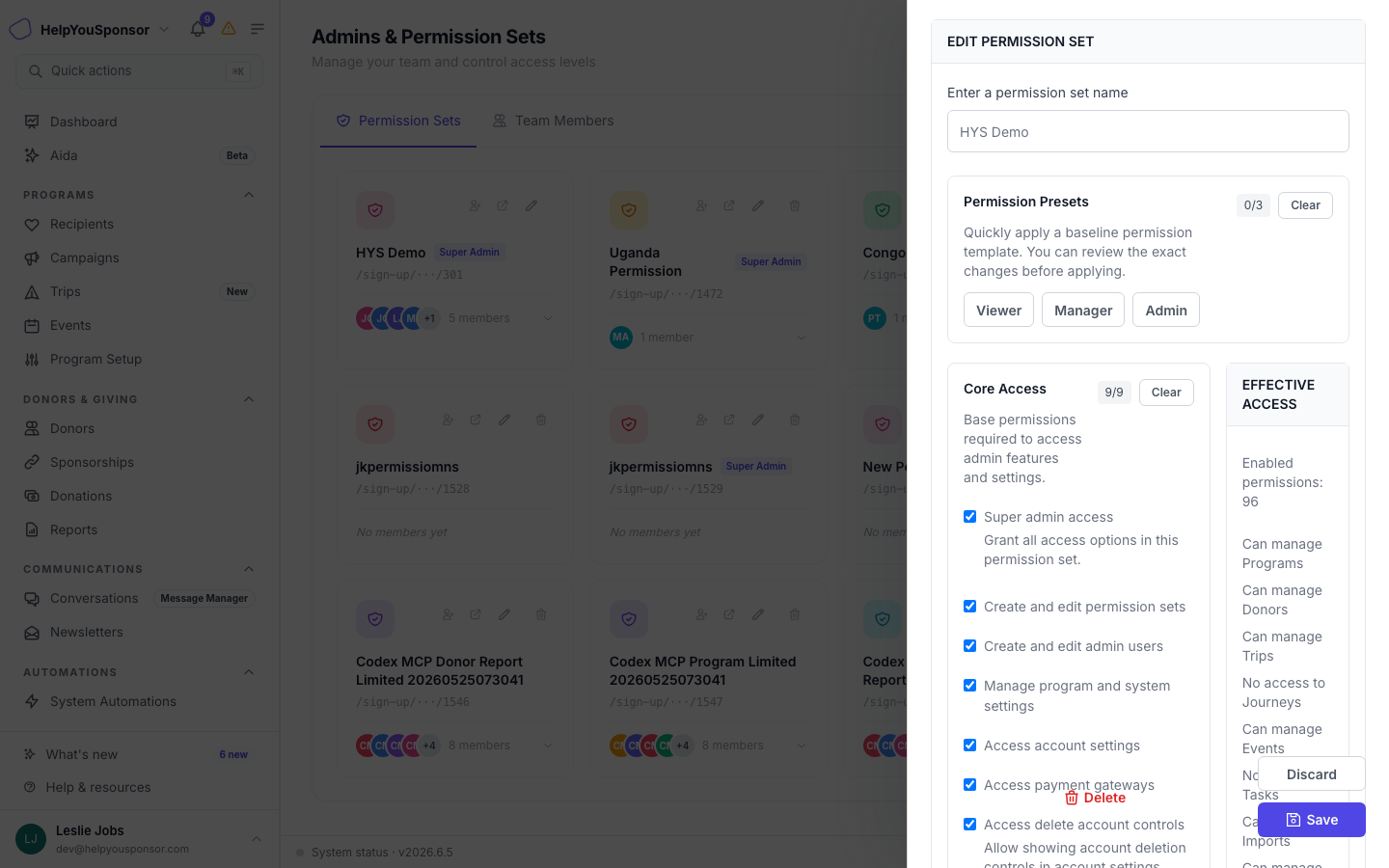
To edit a permission set, click on the pencil icon on the permission set's card. This will open up a drawer with the details of the permission set. The checked checkboxes are the permissions that have been activated for the permission set.

<figure><img src="/files/zDrPp75KCpYTCMQJldih" alt="Edit Permission Set drawer showing configured permission checkboxes" width="500"><figcaption><p>Edit Permission Set drawer showing configured permission checkboxes</p></figcaption></figure>

After editing the permission set to your preference, click Save to update the permission set.

Access grants and restrictions use opposite meanings. Before saving, review the change summary and confirm that checked restrictions are actions you intend to block.

### If access still does not match

1. Confirm which permission set is assigned to the affected admin.
2. Reopen that permission set and compare the module level, program or donor-form scope, setting blocks, and safety restrictions.
3. Save any correction, then ask the admin to reload the app. If the old access remains, sign out and sign back in once.
4. Compare with another admin only when both users are assigned to the same permission set and are testing the same program and page.

If two admins with the same permission set still have different access, or the app returns an access-denied error after the settings are correct, contact support. Include the organization name, both admin email addresses, the permission-set name, the affected page, the program name, and a screenshot or exact error message.

### Deleting a permission set

To delete a permission set, click on the delete icon on the permission set's card. This will pop up a dialog to confirm the deletion. Click Confirm to delete the permission set.