> For the complete documentation index, see [llms.txt](https://docs.helpyousponsor.com/guides/llms.txt). Markdown versions of documentation pages are available by appending `.md` to page URLs; this page is available as [Markdown](https://docs.helpyousponsor.com/guides/getting-started/dashboard.md).

# Dashboard

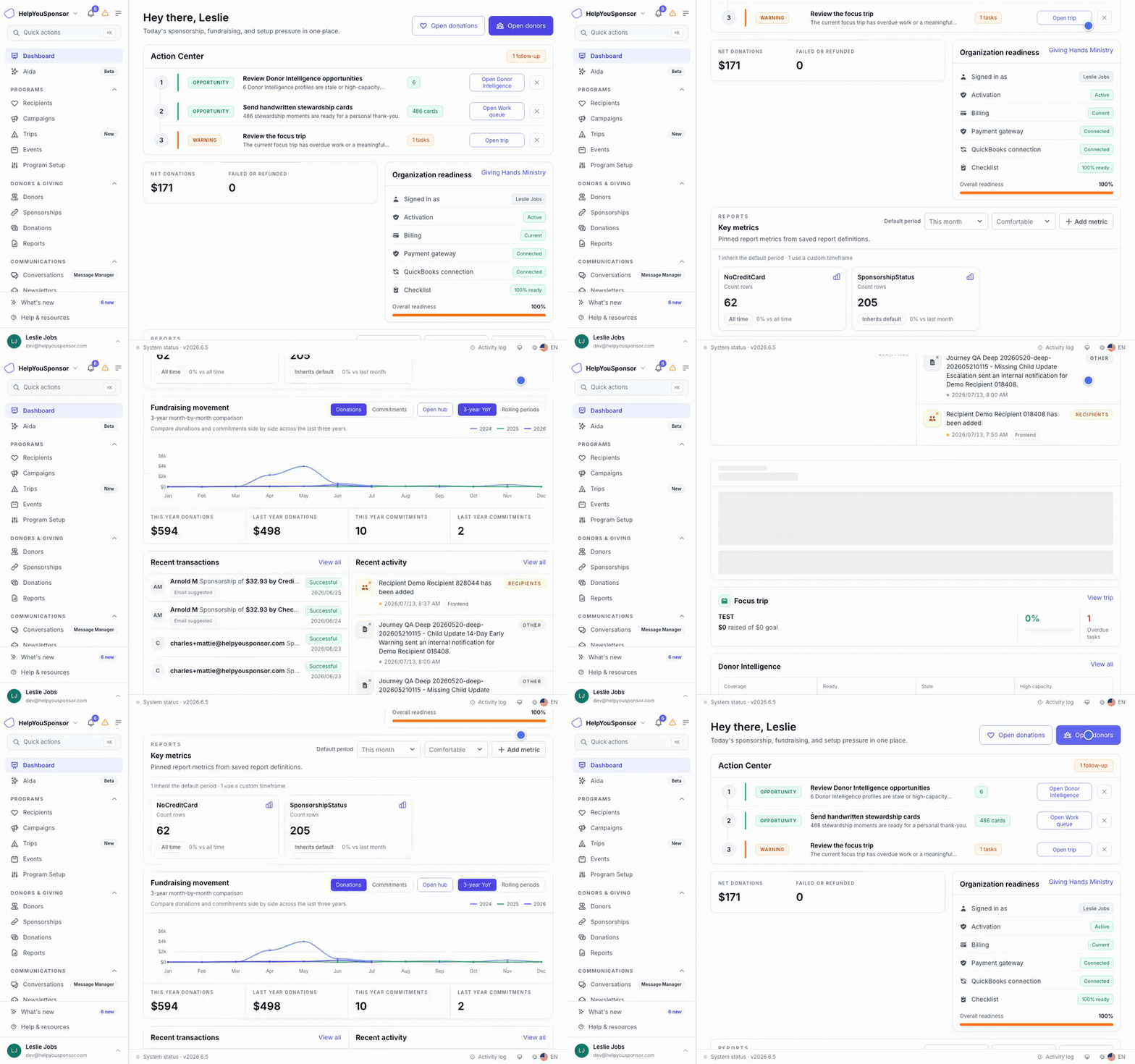
The Dashboard is your admin home page in HelpYouSponsor. Use it to decide what needs attention next across account readiness, priority actions, giving activity, program pressure, trips, wealth insights, reports, and recent activity.

The dashboard is permission-aware. Your account may not show every section in this guide, and some sections appear only when the related feature is enabled for your organization.

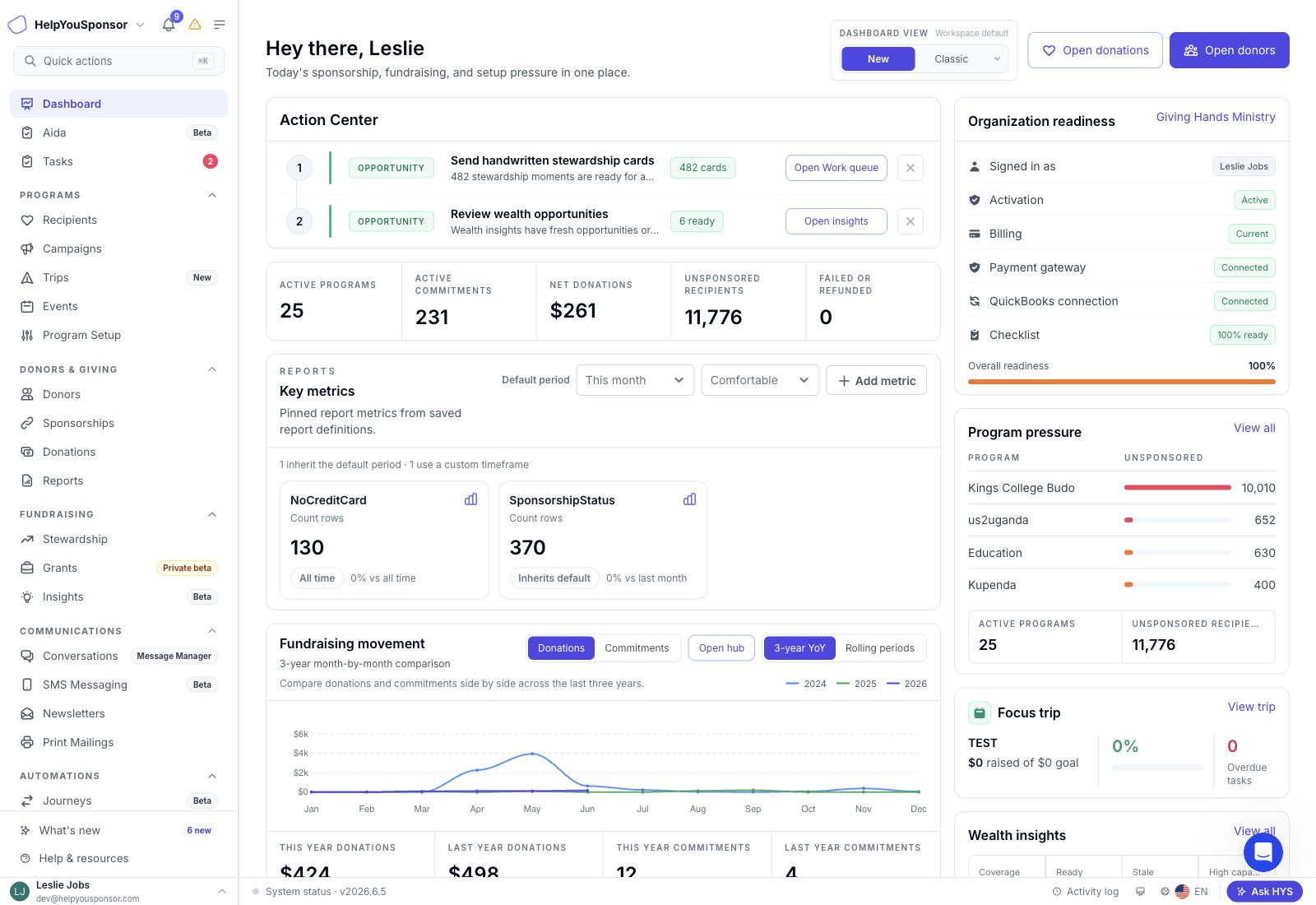
<figure><img src="/files/EFgnh35AL0YQp3YplCz8" alt=""><figcaption><p>Dashboard with the new dashboard view selected on a desktop screen.</p></figcaption></figure>

### Choose the dashboard view

The dashboard has two views:

* **New:** Shows the action-first dashboard with readiness, priority actions, fundraising, report metrics, program, trip, wealth, and activity sections.
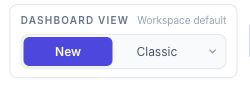
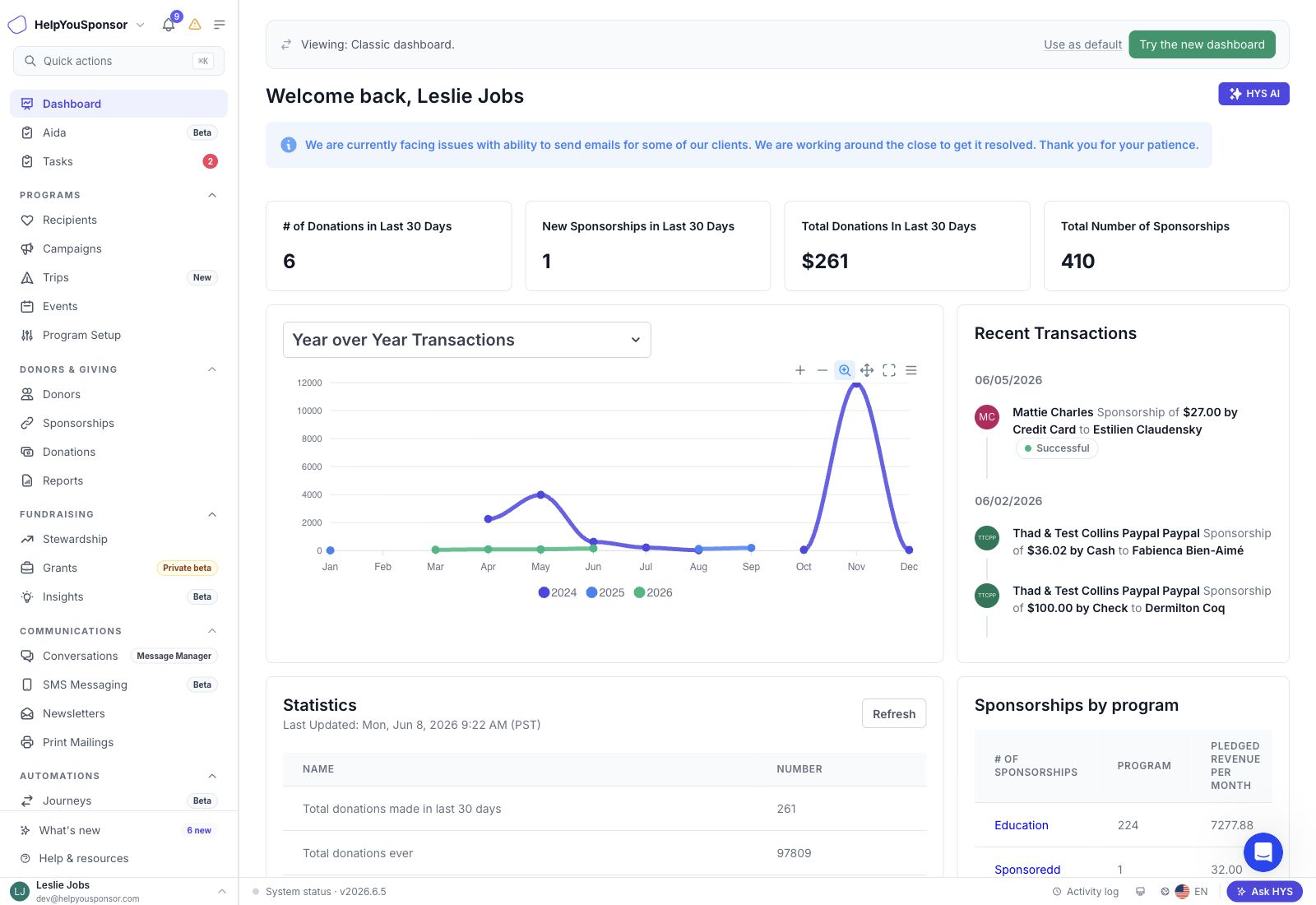
* **Classic:** Shows the previous dashboard layout with statistic cards, donation and commitment charts, recent transactions, latest statistics, program sponsorships, and sponsorships by program.

Use **Dashboard view** near the top of the page to switch between New and Classic. If your current view is not the workspace default, use **Use as default** to make it the default view for the workspace.

<figure><img src="/files/UszHPlnRrXJasxY4BymX" alt=""><figcaption><p>Dashboard view control for switching between the New and Classic dashboard.</p></figcaption></figure>

If the New dashboard cannot load, HelpYouSponsor may show the Classic dashboard instead.

### Open common work quickly

The top of the dashboard includes:

* **Open donations:** Opens the donations page.
* **Open donors:** Opens the donors page.
* **Dashboard view:** Switches between the New and Classic dashboard.
Use these actions when you want to leave the dashboard and work directly with donors or giving records.

### Work through priority actions

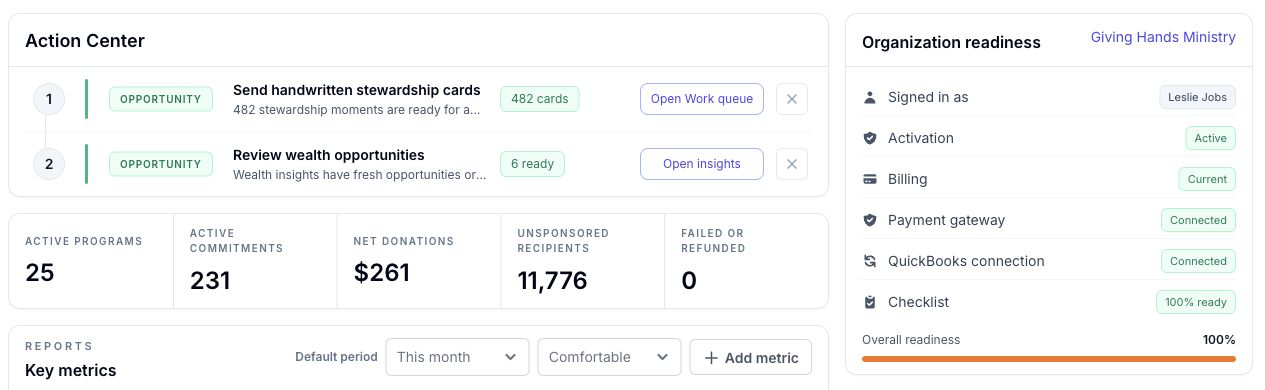
The **Action Center** lists the most important items that need attention. Each action includes a severity, a short reason, a metric when available, and a button that opens the related page.

<figure><img src="/files/mU5Igx3CqLIpQijLrHet" alt=""><figcaption><p>Action Center with priority actions and organization readiness.</p></figcaption></figure>

Examples of Action Center items include:

* Verifying your admin account.
* Connecting a payment provider.
* Resolving billing issues.
* Finishing setup checklist items.
* Reconnecting email and calendar sync.
* Reviewing unmatched donor interactions.
* Responding to inbound donor emails.
* Following up on failed or refunded donations.
* Reviewing a focus trip.
* Opening wealth insight opportunities.

Use **View all actions** when there are more items than the dashboard shows by default. You can dismiss an action for the current session, and restore dismissed actions when needed.

### Review organization readiness

The **Organization readiness** section shows setup and account health signals for your organization.

It can include:

* Signed-in admin.
* Activation status.
* Billing status.
* Payment gateway status.
* QuickBooks connection status.
* Setup checklist progress.

When something needs attention, the dashboard may also show a matching Action Center item with a button to open the related setup page.

### Review operating metrics

The **Executive snapshot** gives you a quick set of key metrics. Depending on your permissions and account data, it can include:

* Active programs.
* Active commitments.
* Net donations.
* Unsponsored recipients.
* Failed or refunded donations.

Some metrics are clickable and open the related page, such as Donations or Recipients.

### Pin report metrics

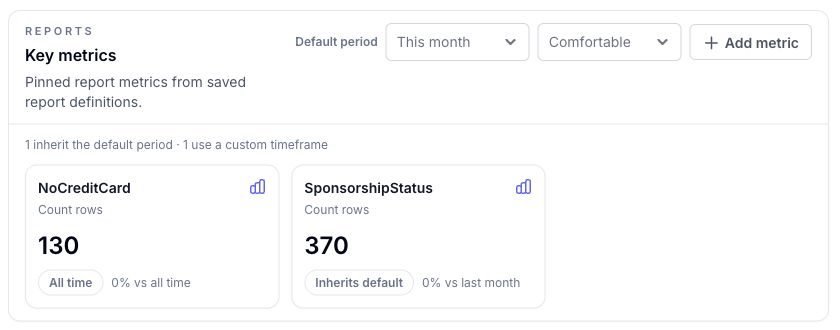
The **Key metrics** section shows metrics pinned from saved report definitions. Use it when you want selected report numbers to stay visible on the dashboard.

<figure><img src="/files/K4SeTizGb3Hn2arwhRXQ" alt=""><figcaption><p>Key metrics section with report metric tiles and dashboard period controls.</p></figcaption></figure>

You can:

* Change the dashboard **Default period** for pinned metrics.
* Switch between **Comfortable** and **Compact** density.
* Open a metric tile to review the related report worksheet.
* Use **Add metric** to pin another report metric when you have permission to manage reports.

When adding a metric, choose the report, choose the metric, and either inherit the dashboard default period or select a custom period. Snapshot reports are pinned as point-in-time metrics.

### Track fundraising movement

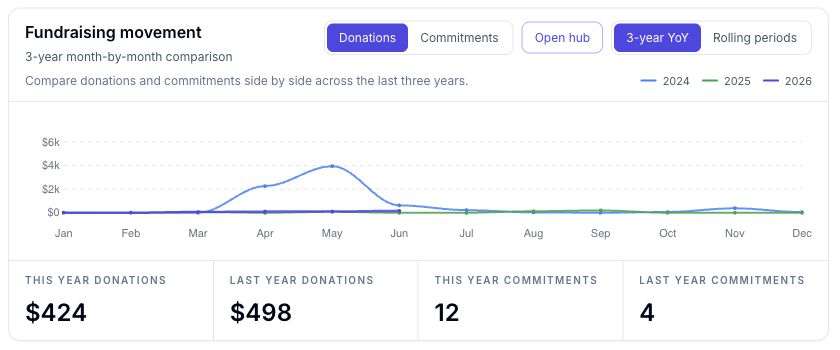
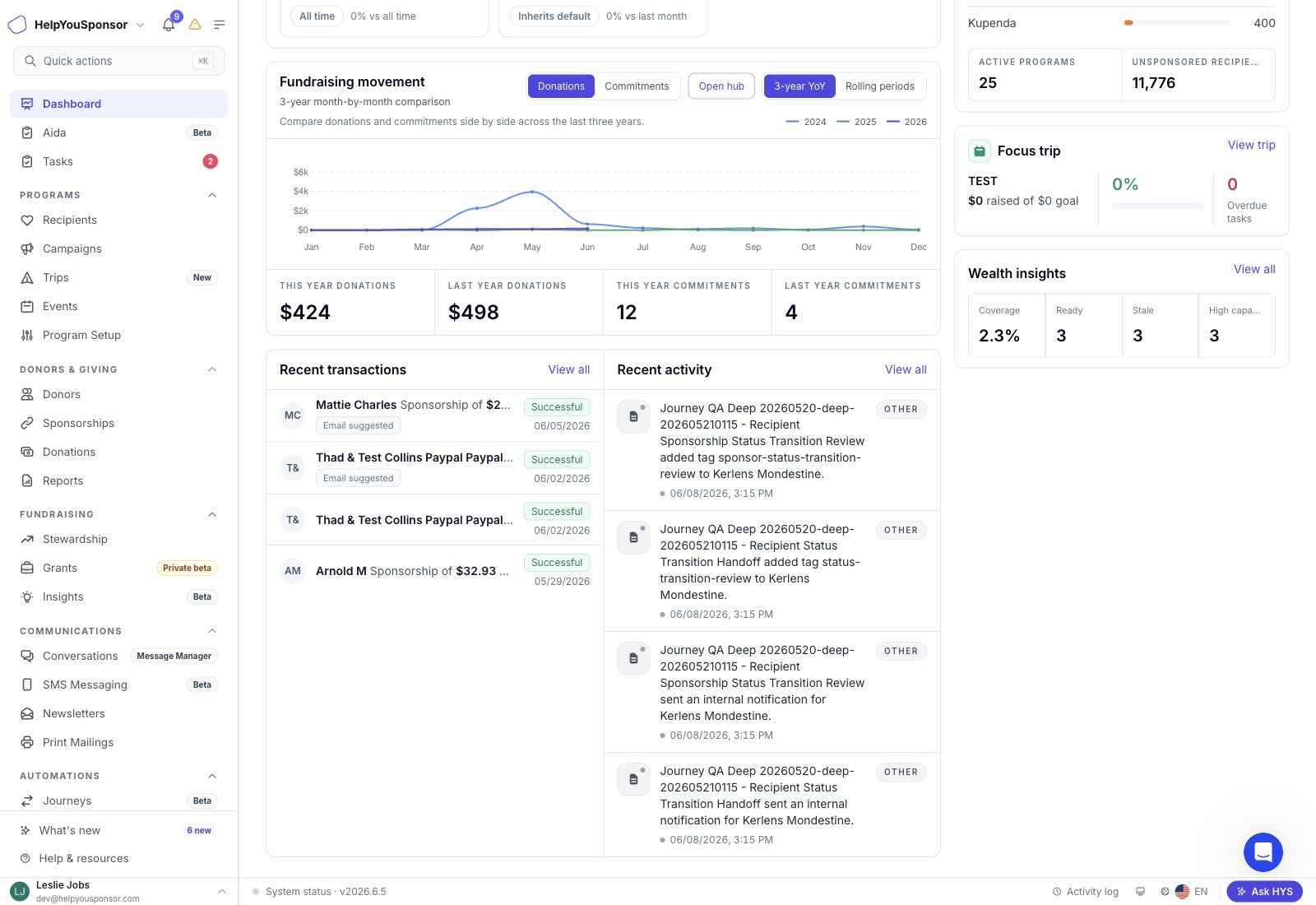
The **Fundraising movement** section helps you review giving and commitment trends.

<figure><img src="/files/pVzzDczzKaviIQvPJXko" alt=""><figcaption><p>Fundraising movement chart with donation and commitment trend controls.</p></figcaption></figure>

You can switch between:

* **Donations** and **Commitments**.
* **3-year YoY** comparison.
* **Rolling periods**, including 30D, YTD, and 12M.

Use **Open hub** to review fundraising activity in the fundraising hub.

### Review recent work

The **Recent activity** section shows recent transactions and, when you have permission, activity log events.

<figure><img src="/files/KOeoHmQGKEmkz7d0T85d" alt=""><figcaption><p>Recent transactions and activity log events on the dashboard.</p></figcaption></figure>

Use this section to review recent donations, sponsorship payments, failed payments, refunds, and other recent account activity. Transaction rows can open the related donor record when a donor is available.

On desktop, recent transactions and recent activity can appear side by side. On smaller screens, use the tabs to switch between **Transactions** and **Activity**.

### Watch program, trip, and wealth pressure

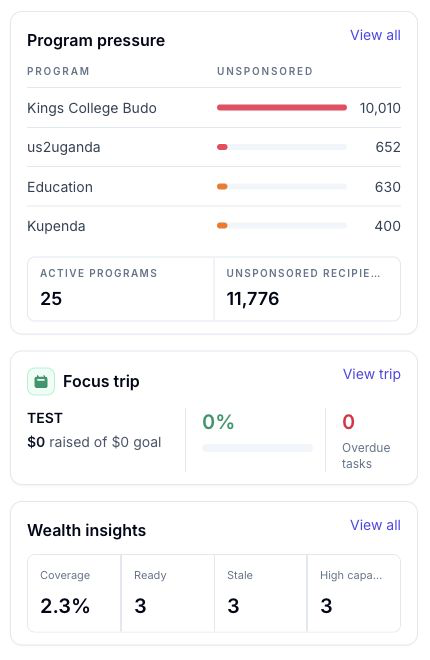
The **Program pressure** section highlights programs with unsponsored recipients or active sponsorship load. Use **View all** to open the Recipients page and review program details.

When trips are enabled and active trips exist, the dashboard can show a **Focus trip** card. This card highlights a trip that may need attention based on fundraising progress or overdue tasks. Use **View trip** to open the trip details page.

When Wealth Insights is enabled for your account, the dashboard can show a **Wealth insights** card with:

* Coverage.
* Ready insights.
* Stale insights.
* High-capacity opportunities.

Use **View all** to open the Insights page.

<figure><img src="/files/6RP4GwtimVZTS9REZJqW" alt=""><figcaption><p>Program pressure, focus trip, and wealth insights cards.</p></figcaption></figure>

For the full workflow, see [Wealth Insights](/guides/core-features/donor-management/wealth-insights.md).

### Finish setup

If your setup checklist is incomplete and you have permission to manage setup, the dashboard can show a **Setup checklist** card. The card shows the next setup items, quick actions for those items, and a link to view the full checklist.

Some checklist items open the related setup page. Others can be marked done from the dashboard when they do not require another page.

### Use the Classic dashboard

The Classic dashboard remains available for users who prefer the previous layout. It includes:

* Statistical cards.
* Donation and commitment charts.
* Recent transactions.
* Latest statistics.
* Program sponsorship summaries.
* Sponsorships by program.

<figure><img src="/files/UA5CwEhicHChivnRl1ki" alt=""><figcaption><p>Classic dashboard with statistic cards, charts, recent transactions, and program summaries.</p></figcaption></figure>

### Related guides

* [Navigation](/guides/getting-started/navigation.md)
* [Donation Management](/guides/core-features/donation-management.md)
* [Donor Management](/guides/core-features/donor-management.md)
* [Manage Programs & Campaigns](/guides/core-features/program-management/manage-programs-and-campaigns.md)
* [Trips](/guides/core-features/program-management/trips.md)
* [Reporting and Analytics](/guides/advanced-features/reporting-and-analytics.md)


---

# Agent Instructions
This documentation is published with GitBook. GitBook is the documentation platform designed so that both humans and AI agents can read, navigate, and reason over technical content effectively. Learn more at gitbook.com.

## Querying This Documentation
If you need additional information that is not directly available in this page, you can query the documentation dynamically by asking a question.

Perform an HTTP GET request on the current page URL with the `ask` query parameter:

```
GET https://docs.helpyousponsor.com/guides/getting-started/dashboard.md?ask=<question>
```

The question should be specific, self-contained, and written in natural language.
The response will contain a direct answer to the question and relevant excerpts and sources from the documentation.

Use this mechanism when the answer is not explicitly present in the current page, you need clarification or additional context, or you want to retrieve related documentation sections.