> For the complete documentation index, see [llms.txt](https://docs.helpyousponsor.com/guides/llms.txt). Markdown versions of documentation pages are available by appending `.md` to page URLs; this page is available as [Markdown](https://docs.helpyousponsor.com/guides/core-features/program-management/program-forms.md).

# Program Forms

Use Program Forms when you need to decide what information HelpYouSponsor should collect for donors, recipients, or households. A form is the structure behind the fields people fill out in admin workflows, public signup and checkout pages, recipient profiles, donor profiles, reports, imports, and merge tags.

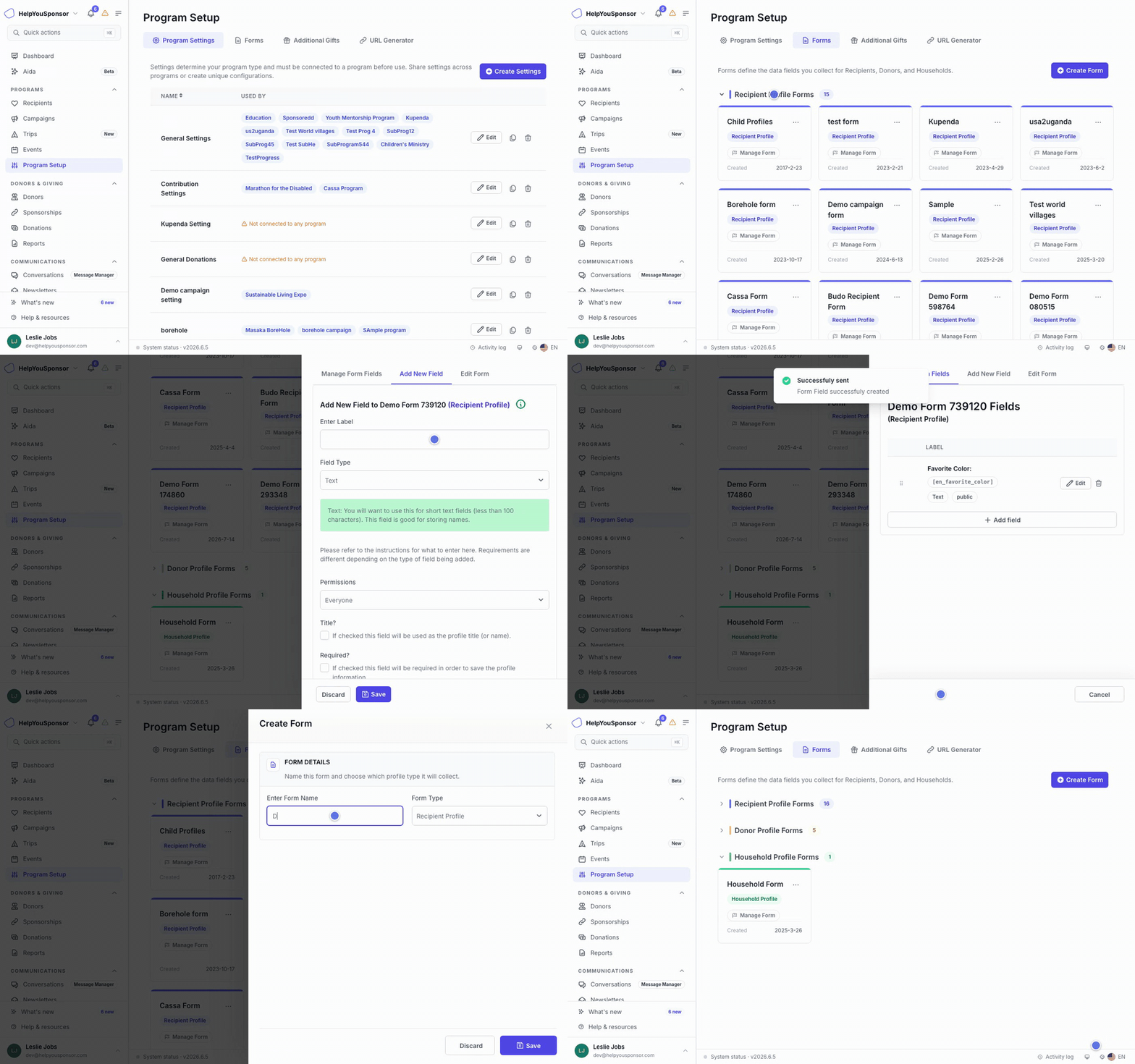
<figure><img src="/files/fdGXb64yQpGa1BczjPdn" alt=""><figcaption><p>Program Settings > Forms groups recipient, donor, and household profile forms by type.</p></figcaption></figure>

<figure><img src="/files/45ofRQUbRrQzOuhI8zfh" alt="Animated walkthrough of program forms"><figcaption><p>Walkthrough: adding a field to a form and creating a new form from the Forms tab.</p></figcaption></figure>

## Choose the Right Form

Choose the form based on the record you want to collect information for:

* **Recipient Profile**: use this for the person, project, campaign designation, or other recipient that donors can sponsor or support.
* **Donor Profile**: use this for donor information collected in admin, signup, checkout, imports, and donor-facing workflows.
* **Household Profile**: use this for additional household information connected to household records.

Progress reports are managed separately. Use progress report forms when you need to archive repeatable updates, contact records, or survey-style records for donors or recipients. See [Progress Reports](https://github.com/rg-repos/hys/tree/hys_docs/docs/guides/progress-report/README.md).

## Create a Form

Create a form before you attach it to a program or use it for collecting records.

1. Open **Program Settings**.
2. Select the **Forms** tab.
3. Select **Create Form**.
4. Enter a form name. The name must be at least five characters.
5. Choose the form type.
6. Select **Save**.

<figure><img src="/files/owFwgqK8F9lZ1DZyA6uO" alt=""><figcaption><p>The Create Form drawer asks for the form name and profile type.</p></figcaption></figure>

Keep these rules in mind:

* An account can create one donor profile form and one household profile form. Older accounts may still show legacy donor forms that were created before this limit.
* A form type cannot be changed after the form is created.
* New donor forms should use standardized donor fields unless your team has a specific reason to keep a legacy custom-field setup.

If you choose the wrong type, create a new form with the correct type and move your setup to that form.

## Manage Form Fields

Use fields to decide what information the form collects and how that information appears across HelpYouSponsor.

1. Open **Program Settings**.
2. Select the **Forms** tab.
3. Find the form you want to update.
4. Select **Manage Form**.

The drawer opens with **Manage Form Fields** and **Add New Field**. Donor forms may also show **Standard Fields**, **Custom Fields**, and **Program Overrides** inside the field-management area.

<figure><img src="/files/ZZqM0ZTHGfQWXGUsPLAn" alt=""><figcaption><p>Manage Form Fields shows field labels, shortcodes, field settings, drag handles, edit actions, and delete actions.</p></figcaption></figure>

The field list shows:

* the field label
* the shortcode, such as `[en_first_name]` or `[dn_phone]`
* field type and visibility tags
* required, title, sortable, filterable, unique, bio, conditional, or featured-card indicators when enabled
* drag handles for changing field order
* edit and delete actions

Shortcodes are used in places such as [Auto Emails](/guides/core-features/communication-tools/auto-emails.md) and message templates. Reordering fields changes the order users see when they fill out or edit that form.

## Add a Field

Use **Add New Field** when you need to collect a new piece of information.

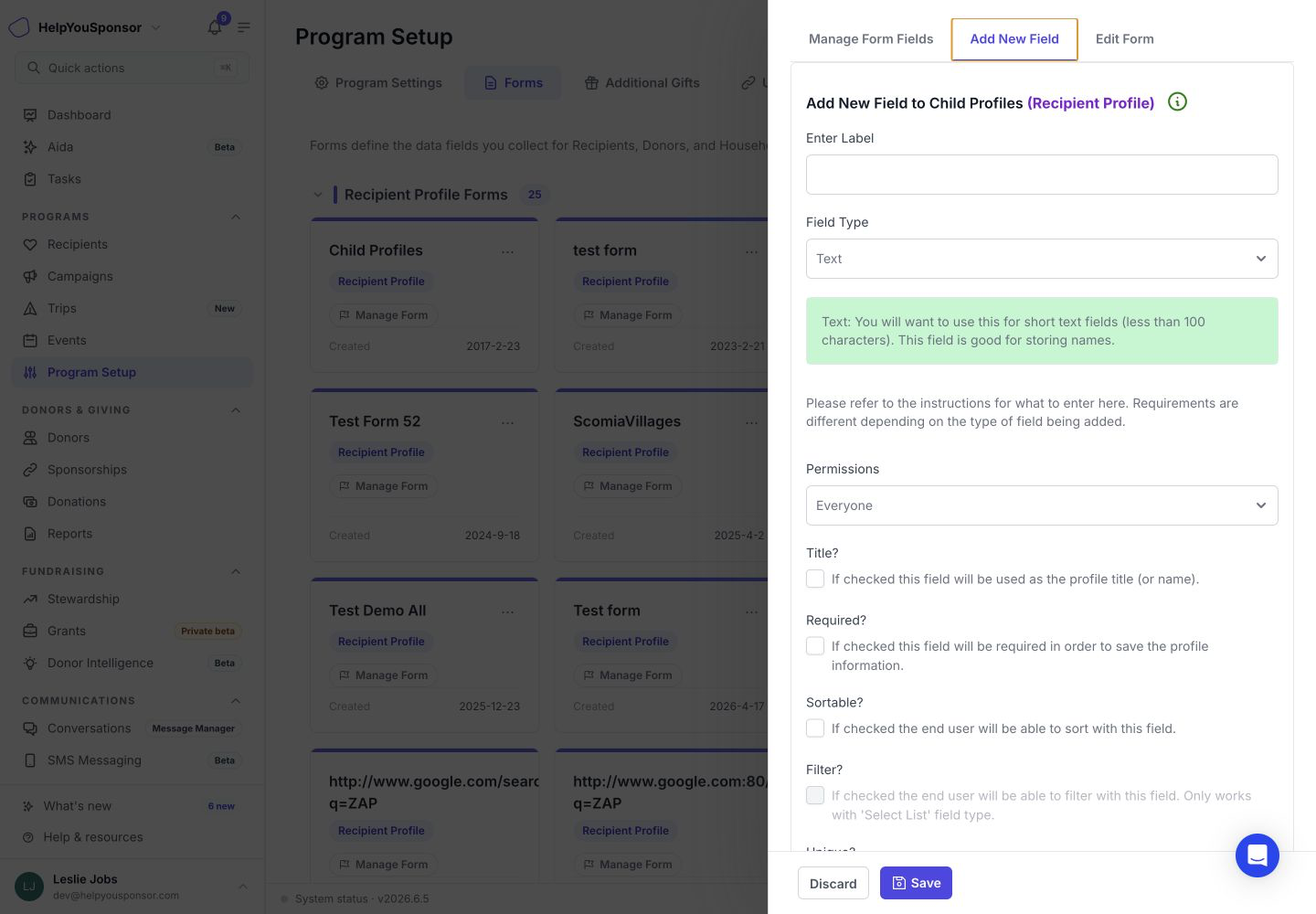
<figure><img src="/files/0iixwpR9XlNGII1W597Q" alt=""><figcaption><p>The Add New Field drawer controls the label, field type, visibility, validation, and display behavior for a form field.</p></figcaption></figure>

Choose the field settings based on what you want the user to do:

* **Enter Label**: the field name users see, such as `Preferred Name`, `Birthday`, or `School Grade`.
* **Field Type**: the input style. Available types include Text, Textarea, Static Text, Age, Date, Link, Select List, Radio, Checkbox, Table, and Auto Increment ID.
* **Enter data for field**: used by Select List, Radio, Checkbox, Static Text, and Table fields. For list-style fields, enter options separated by commas.
* **Permissions**: choose who can see the field. **Everyone** is public, **Donor and Admins** is visible to logged-in donors and admins, and **Admins Only** is only visible in admin areas.
* **Used by Donor Type**: on donor forms, choose whether the field applies to Individual donors, Organization donors, or All donors.
* **Title**: use the field as part of the display name for the donor or recipient.
* **Required**: require the field before the profile can be saved.
* **Conditional display**: on donor forms, show a field only when an earlier Select List or Radio answer matches.
* **Sortable**: on recipient fields, allow the field to be used for sorting recipient records.
* **Filter**: on recipient Select List fields, allow the field to be used for filtering.
* **Unique**: on recipient Text or Auto Increment ID fields, require the value to be unique within the form.
* **Use as Bio**: on recipient Text or Textarea fields, use the field as the recipient bio on sponsorship pages.
* **Feature on Sponsorship Card**: on public, non-table recipient fields, show the value as a tag on recipient cards.
* **Editable by Recipient**: on recipient fields, allow recipients to edit the field from the recipient portal profile editor.

## Manage Donor Standard Fields

Donor forms can include standard fields for common donor information such as name, email, phone, and address. Use **Standard Fields** to control which standard fields are required, which ones build the donor display name, and who can see each field.

<figure><img src="/files/YLMTkIr9iQ2oJW7YIhDO" alt=""><figcaption><p>Standard Fields lets you configure donor title, permission, and required settings for donor profile fields.</p></figcaption></figure>

Use **Custom Fields** for donor information that is specific to your organization, such as congregation, region, sponsor notes, or communication preferences that are not already covered by a standard field.

The donor email field is always included in Standard Fields. Its required setting follows the donor form's **Don't Require Donor Email** option.

## Adjust Donor Fields by Program

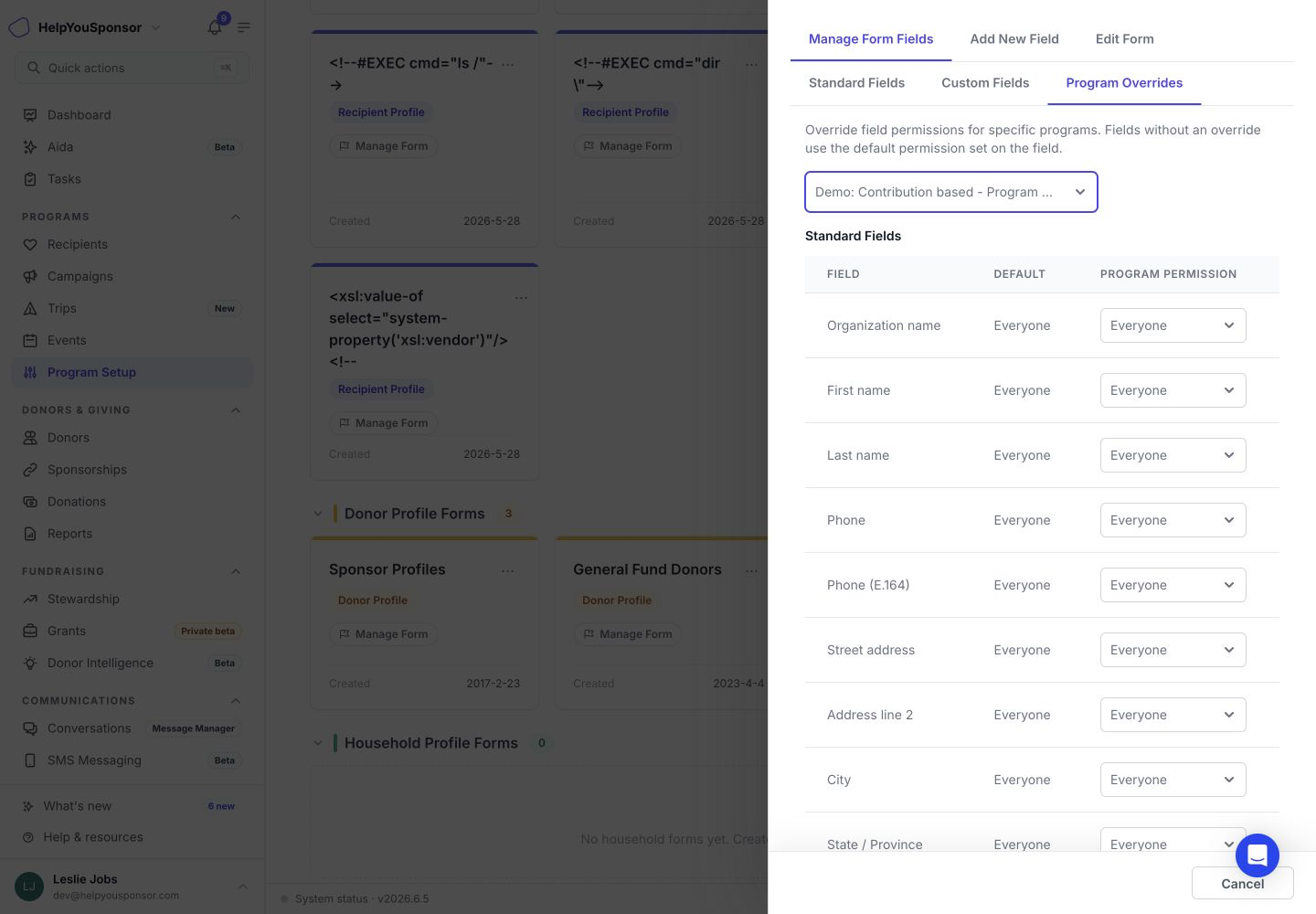
Use **Program Overrides** when the same donor form is used by more than one program, but a field should have different visibility for one program.

1. Open the donor form.
2. Select **Manage Form**.
3. Open **Program Overrides**.
4. Choose a program that uses this donor form.
5. Change the program permission for the needed field.

<figure><img src="/files/9jycFg9mHCX8v6SBXovd" alt=""><figcaption><p>Program Overrides changes donor-field visibility for one program while keeping the form default intact.</p></figcaption></figure>

Fields without an override use the default permission from the form. If you change a program permission back to the default, HelpYouSponsor removes the override.

## Attach Forms to a Program

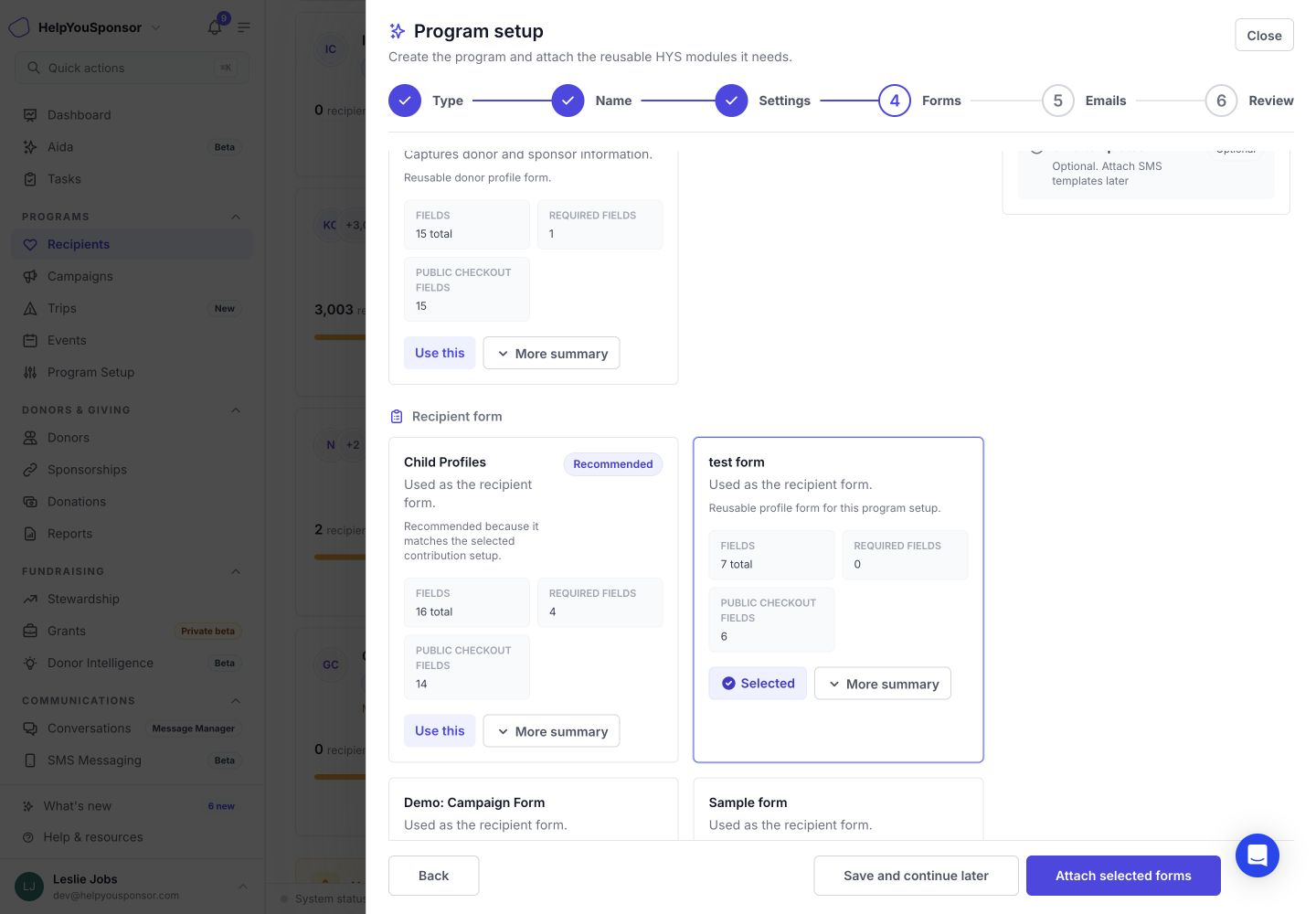
Creating a form does not automatically make a program use it. Attach the donor and recipient forms to the program that should collect those fields.

<figure><img src="/files/HbbpF8UleTLqyJCoIj9H" alt=""><figcaption><p>The program setup forms step attaches the donor and recipient forms that power program records and public workflows.</p></figcaption></figure>

Attached forms control:

* recipient fields shown when admins add or edit recipients
* recipient fields shown on public sponsorship pages
* donor fields collected during signup or checkout
* donor and recipient fields available in imports, reports, saved views, and merge tags
* donor and recipient fields available in email and SMS shortcodes

You can attach forms during program setup or from a program's manage/setup area. If you create a form from inside the program setup flow, the new form becomes available to attach after it is saved.

## Use the Bulk Editor

The three-dot menu on a form card includes **Bulk Editor**. This opens a JSON editor for changing several fields at once.

Use the Bulk Editor only when you are comfortable editing structured field data. Removing an object can remove a field, adding an object can create a field, and changing field values can update existing fields. Invalid JSON or invalid field settings can prevent the update from saving.

## Delete Forms or Fields

Delete fields only when you are sure the field is no longer needed. Deleting a field removes it from the form and can affect records, views, reports, imports, public pages, and merge tags that depend on it.

Delete a form only when the form is not needed anywhere. HelpYouSponsor may block deletion when records depend on that form, such as donors on a donor form or recipients connected to a recipient form.

## Related Guides

* [Manage Programs](/guides/core-features/program-management/manage-programs-and-campaigns.md)
* [Program Settings](/guides/core-features/program-management/program-settings.md)
* [Add Recipient](/guides/core-features/recipient-management/add-recipient.md)
* [Donors Table](/guides/core-features/donor-management/donors-table.md)
* [Auto Emails](/guides/core-features/communication-tools/auto-emails.md)